
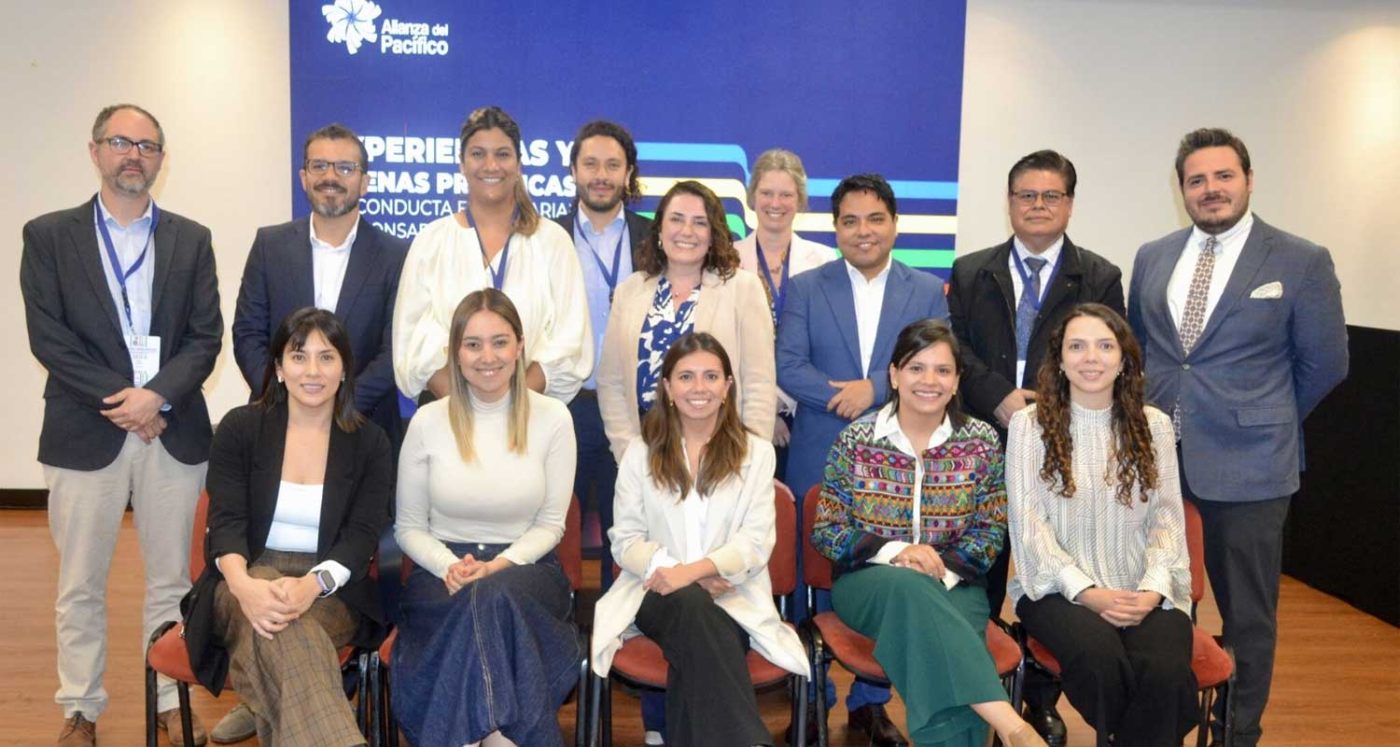
September 8 and 9, 2025. – On September 8, as part of the study “Experiences and Good practices in Responsible Business Conduct (RBC) in the Pacific Alliance countries,” funded by the Pacific Alliance Fund and developed by Conscientia, a face-to-face meeting was held in Bogotá, bringing together representatives from the governments of Chile, Colombia, Mexico, and Peru. Members of the Technical Group on Environment and Green Growth and the Subgroup on Responsible Business Conduct participated with the aim of reviewing the progress and preliminary results of the study, as well as promoting joint reflection on the challenges and opportunities for further strengthening the RBC agenda in the region.
During this event, the official launch of the OECD Regional Platform for Training and Dialogue on Responsible Business Conduct (RBC), Trade, and Investment was also celebrated. This initiative is part of the Responsible Business Conduct in Latin America and the Caribbean (CERALC) project, funded by the European Union and implemented in conjunction with the ILO and OHCHR.
This training space, inaugurated with the participation of more than 70 public officials from 12 countries in Latin America and the Caribbean, seeks to consolidate a community of practice to promote responsible business conduct through trade and investment in the region. The event was attended by representatives of governments, multilateral organizations, and National Contact Points, reaffirming the regional commitment to more responsible, sustainable, and human rights-aligned business conduct.
As part of the activities to disseminate the study on Experiences and Good Practices in Responsible Business Conduct (RBC) in the countries of the Pacific Alliance, a public event was held in Bogotá on September 9, bringing together representatives from governments, international organizations, businesses, trade associations, civil society, and academia, with the aim of strengthening this agenda in the region. The event was held in the Mario Laserna Auditorium of the Uniandinos Association and was broadcast live on the Pacific Alliance’s Facebook Live channel, allowing for a wider reach and facilitating the participation of actors from different countries.
The event opened with remarks by María Mesonero, representing the Pacific Alliance, and Camila Miranda, director of Conscientia, who highlighted the importance of RBC as a condition for competitiveness, sustainability, and social legitimacy.
One of the highlights was the live podcast “Panorama of RBC in Latin America,” hosted by José Fernando Gómez (CREER) together with Carlos de la Torre, from the United Nations High Commissioner for Human Rights in Colombia. The conversation underscored the need to integrate human rights into complex economic environments as an opportunity to generate virtuous circles and real transformations in the territories where companies operate. De la Torre highlighted the urgency of translating standards into concrete practices, pointing out the potential of the Pacific Alliance as a regional platform to align common efforts and serve as an international benchmark in RBC matters.
The RBC Talks offered key insights into the challenges facing the region:
- Miguel Castro, OECD Focal Point for Latin America and the Caribbean, emphasized that adopting international standards not only strengthens reputation, but also opens markets and ensures long-term sustainability. He emphasized the importance of energy transitions and critical minerals, noting that their use will be decisive for regional competitiveness, provided that communities, people, and the environment are placed at the center. He also highlighted the opportunity for the Pacific Alliance to establish regional RBC frameworks that enable productivity, development, and just transitions, with responsible business conduct as a compass.
- Rosa Peña, from the Interamerican Association for Environmental Defense (AIDA), began her speech by highlighting water as a fundamental element for life. She clarified that it is not a question of opposing development, but of preventing it from taking place at the expense of people’s health and lives. She reminded the audience that companies are not only economic actors, but also social actors embedded in a territory, with responsibilities towards communities and the climate crisis. She stated emphatically: “Without responsibility, there is no future.”
- Juan Ibáñez, Secretary General of the Catholic University of Chile, presented the five tools of sustainability: purpose, due diligence, materiality, stakeholders, and ethics and compliance. He pointed out that these tools are available and have proven to be effective. “The present is ours. We owe it to our stakeholders and future generations. Let’s implement them,” he said in a call to move from theory to action.
The meeting also included the presentation of the RBC Study in the Pacific Alliance, by Camila Miranda and Diana Muñoz (Conscientia). The analysis highlighted common trends in the four countries, progress by country, and notable initiatives, along with persistent gaps in policy implementation and strategic opportunities to consolidate a shared agenda.
In the final phase, attendees participated in thematic working groups (human rights, environment, corporate governance and transparency, and local development and competitiveness), where they developed concrete recommendations that will be included in the final report.
The closing remarks were given by Humberto Cantú (University of Monterrey), who emphasized that Responsible Business Conduct is no longer aspirational but has become an indispensable condition for development. He stressed that the key lies in collaborative and multi-stakeholder work and in the ability of the Pacific Alliance countries to transform reflections into sustainable and replicable actions. He also highlighted the need to move towards a structural and regional vision of a regulatory framework for RBC, and to strengthen the cross-cutting nature of this agenda in foreign trade as a strategic element for the bloc’s competitiveness and international legitimacy.
With this event, the Pacific Alliance reaffirmed its commitment to move towards a development model based on Responsible Business Conduct, which balances economic growth, respect for human rights, and environmental sustainability.