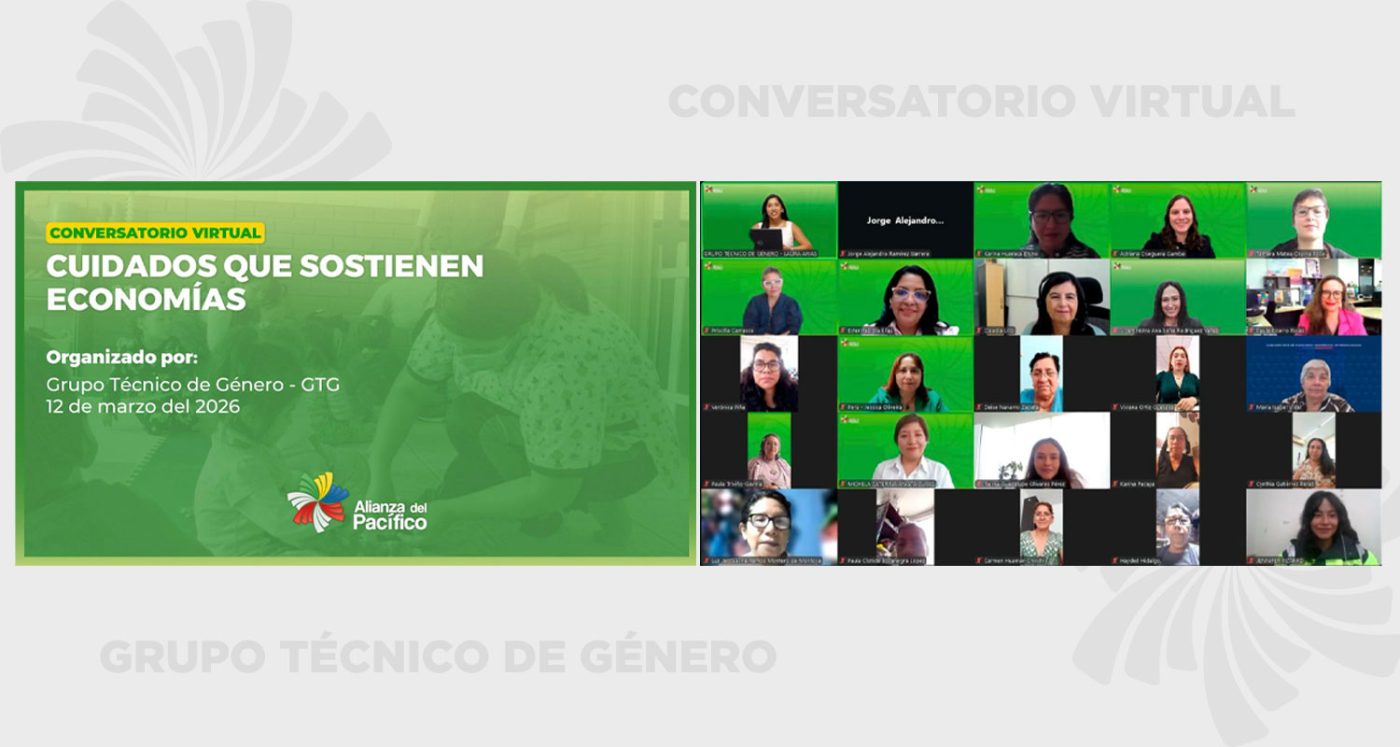
March 17, 2026.- On the occasion of International Women’s Day, the Pacific Alliance Gender Technical Group held the virtual forum “Care That Sustains Economies: From Invisible Work to Shared Responsibility for Women’s Economic Autonomy in the Pacific Alliance.” The forum highlighted the unpaid domestic and care work performed predominantly by women and promoted a more equitable distribution of this work as a condition for strengthening women’s economic autonomy.
The event, livestreamed on March 12 via Zoom, highlighted experiences and best practices that foster greater shared responsibility among the state, the private sector, families, and civil society.
Opening remarks were delivered by Támara Matea Ospina Posse, Vice Minister for Women at Colombia’s Ministry of Equality and Equity, representing the Gender Technical Group’s coordination, and by Ana Sofía Rodríguez Yáñez, Vice Minister for Women at Peru’s Ministry of Women and Vulnerable Populations. Both speakers underscored the role of Latin American women in driving socioeconomic growth through shared care responsibilities.
A regional analysis of progress and challenges on the care agenda in Latin America was presented by Karina Huaraca, Peru Chapter Coordinator of UN Women’s “Transforming Care Economies” project, who stressed the need to coordinate efforts among multiple stakeholders to move toward more comprehensive and functional care systems.
The creation of a National Care System to advance women’s economic autonomy was the central focus among government officials, while private sector representatives from WOM Chile, Granabastos Colombia, and CPS Peru demonstrated their commitment to shared care responsibilities through initiatives such as parental leave, flexible scheduling, family support programs, and workplace training.
The forum reaffirmed the commitment of the Pacific Alliance to women’s economic autonomy and to joint action that contributes to recognizing and redistributing care work, in pursuit of more inclusive and sustainable economies in the region.
The Pacific Alliance thanks the following government officials and company representatives for their participation: Priscilla Carrasco Pizarro (Chile), Paula Triviño Gaviria (Colombia), Adriana Oseguera Gamba (Mexico), and Jessica Oliveira Bardales (Peru); and Francisca Zañartu Neculhueque (WOM Chile), Ester Fabiola Elías Castro (Granabastos, Colombia), and Michela Ayasta Cuba (CPS Peru).